
This decision is made early, usually before the first room is wired, and it is expensive to reverse. Once the conduit is in the wall and the cable is pulled, changing from one method to the other means re-wiring every room.
The choice is not about which switch is better. Both work. It is about cable volume, labour hours, commissioning time and how the system behaves when something breaks. This article sets out the practical differences for contractors specifying a hotel guest room control system.
How Dry Contact Switches Are Wired
A dry contact switch is a passive device. Pressing a button closes a contact, and the RCU host reads that closure on a dedicated input terminal.
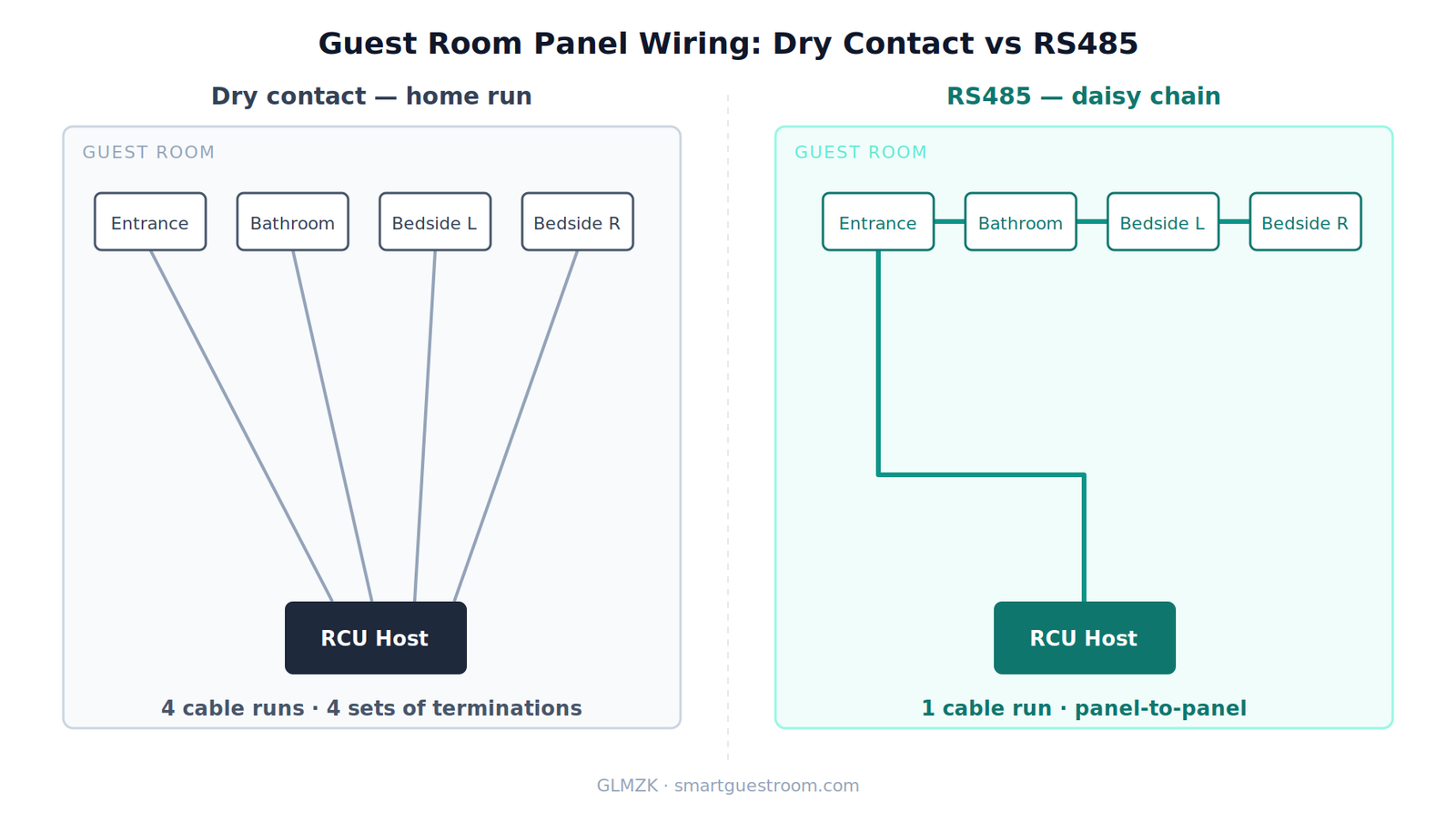
This means every switch needs its own cable run back to the host. One panel with six buttons requires enough conductors for six inputs plus a common return, typically satisfied by a single network cable. But the run itself is dedicated — it goes from that panel to the host and nowhere else.
In a standard guest room with four panel positions — entrance, bathroom group, and two bedside panels — that is four separate cable runs converging on the RCU location.
How RS485 Switches Are Wired
An RS485 switch is an addressed device on a communication bus. Instead of reporting button closures over dedicated conductors, it sends a message on a shared line.
One cable leaves the RCU host, reaches the first panel, continues to the second, then the third, and so on. This is a daisy chain, sometimes called hand-in-hand wiring.
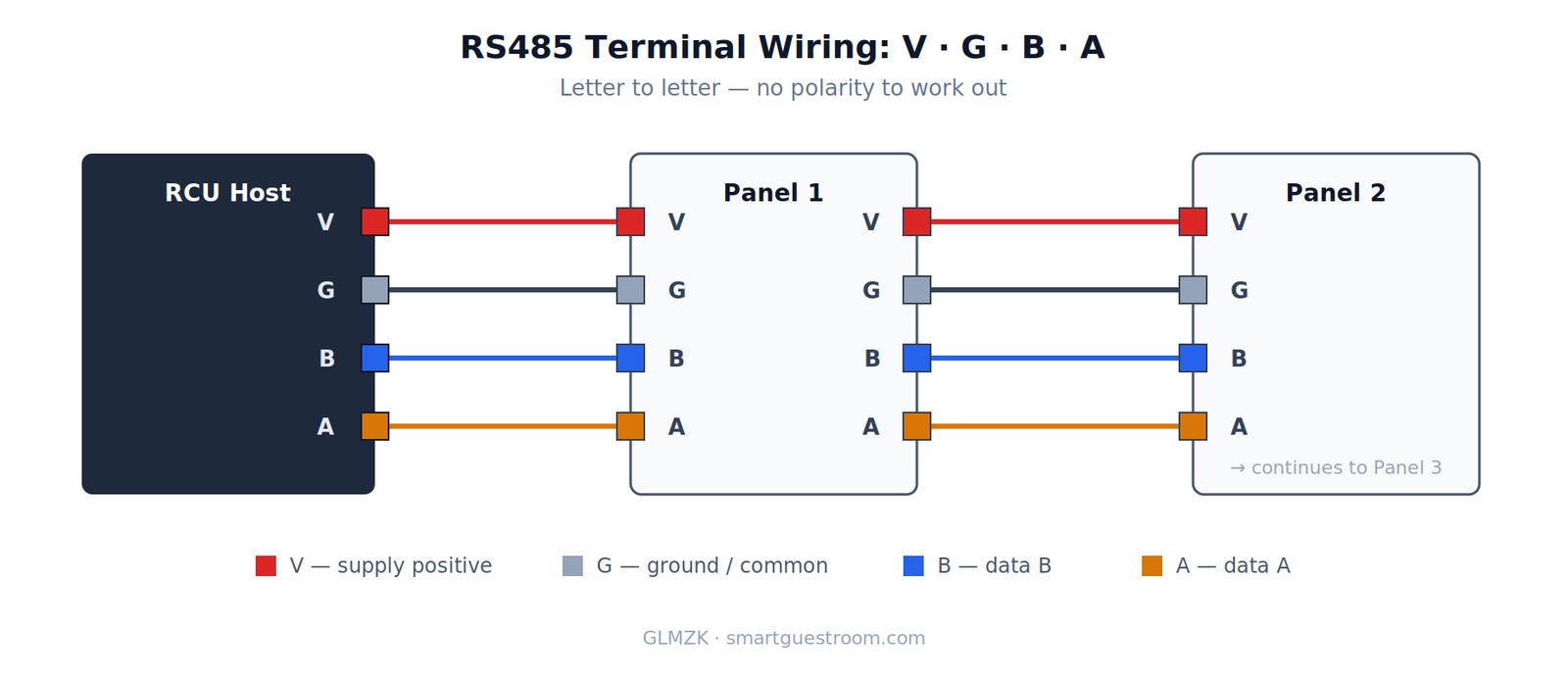
On GLMZK RCU hosts, the RS485 terminals are labelled V, G, B, A:
- V — power supply positive to the panels
- G — ground / common
- B — RS485 data B
- A — RS485 data A
Each panel has the same four terminals marked with the same letters. Wiring is letter-to-letter: V to V, G to G, B to B, A to A. Panel to panel uses the same rule. There is nothing to interpret and no polarity to work out beyond matching the labels.
The Practical Differences
| Dry contact | RS485 | |
|---|---|---|
| Cable runs per room | One per panel | One total |
| Conduit fill at RCU position | High — all runs converge | Low |
| Terminations to make | Many, at the host end | Few |
| Commissioning | Verify each input individually | Address each panel, then verify |
| Adding a panel later | New cable run required | Extend the chain |
| Single cable fault | One panel offline | All downstream panels offline |
The Failure Mode Nobody Mentions Until It Happens
The one real disadvantage of RS485 is chain dependency. If the communication line is cut or a terminal comes loose at panel two, then panels three, four and five all stop responding — even though nothing is wrong with them.
A dry contact fault is contained. Damage the cable to the bathroom panel and only the bathroom panel stops working.
This matters most during construction, when other trades are still working in the room and cable damage is common. It matters less in operation, where the cable is behind plaster and nothing touches it.
How to manage it: segment the chain so that a single fault cannot take out an entire room. Running two shorter chains from the host instead of one long chain means a fault on one side leaves the other side working, which is usually enough for the room to remain sellable while a technician attends.
Which One to Specify
RS485 makes sense when:
- The property has a meaningful number of keys — cable savings compound across rooms
- Room types have four or more panel positions
- Suites, executive rooms or presidential suites are in scope, where panel counts climb sharply
- The programme is tight and commissioning speed matters
- The hotel may add control points later
Dry contact remains reasonable when:
- The property is small and point counts are low
- It is a renovation where existing cable routes already run panel-to-host
- The maintenance team is unfamiliar with addressed devices and prefers a system with no configuration
- Absolute fault containment is required by the client
For the majority of new-build hotel projects with standard twin and king room types, RS485 costs less to install and less to commission. The saving is in labour and conduit, not in the switches themselves.
Mixing Both in One Project
This is common and perfectly workable. Many GLMZK installations use RS485 for the wall panels and dry contact for devices that only report a simple state:
- Door plate — dry contact, one signal per function
- Door contact — dry contact, two wires, no polarity
- Doorbell button — dry contact
- Wall panels — RS485 daisy chain
- Curtain motor — RS485 via RJ45
There is no conflict. The RCU host has both input types, and each device uses whichever suits it.
Recommended Uses
| Application | Recommended method |
|---|---|
| New-build hotel, 80+ keys | RS485 for panels, dry contact for door devices |
| Suites and high point-count rooms | RS485, segmented into two chains |
| Small boutique property under 30 keys | Either; dry contact acceptable |
| Renovation reusing existing conduit | Survey existing routes first, then decide |
FAQ
What cable should be used for the RS485 run?
Shielded twisted pair is preferred for the data pair. Many hotel projects use standard network cable, which works over the short distances inside a guest room. Keep the RS485 run separated from mains cable where possible to avoid interference.
How many panels can be on one chain?
Far more than a single guest room requires. The practical limit inside a room is set by the panel count, not the bus. Segment for fault tolerance, not for capacity.
Do RS485 panels need addressing on site?
Yes — each panel needs a unique address on its chain. GLMZK can pre-address panels by room type before shipment so the installer only mounts and connects them.
Can GLMZK supply both switch types for one project?
Yes. Panels can be supplied in either configuration with the same face design, so the room looks identical regardless of which method is used behind the wall.
Related Solutions
- Smart hotel RCU system
- Guest room control solution
- Hotel lighting and dimming control
- Smart hotel door plate
Contact GLMZK
GLMZK manufactures hotel RCU systems, RS485 and dry contact guest room panels, door plates and key card power switches. We supply contractors and system integrators worldwide, with OEM panel design and full wiring documentation.
Send us your room type, key count and control point list, and we will return a panel schedule and wiring diagram.
Request a specification sheet and quotation | sales@smartguestroom.com