
The objection to smart room control in an operating hotel is almost never the product cost. It is the closure. Chasing walls to run new lighting circuits means the floor comes out of service, and for a property running at reasonable occupancy, lost room nights cost more than the control system.
There is a way to add lighting control without touching the lighting circuits at all. This article explains how it works, what it can and cannot do, and which properties it suits.
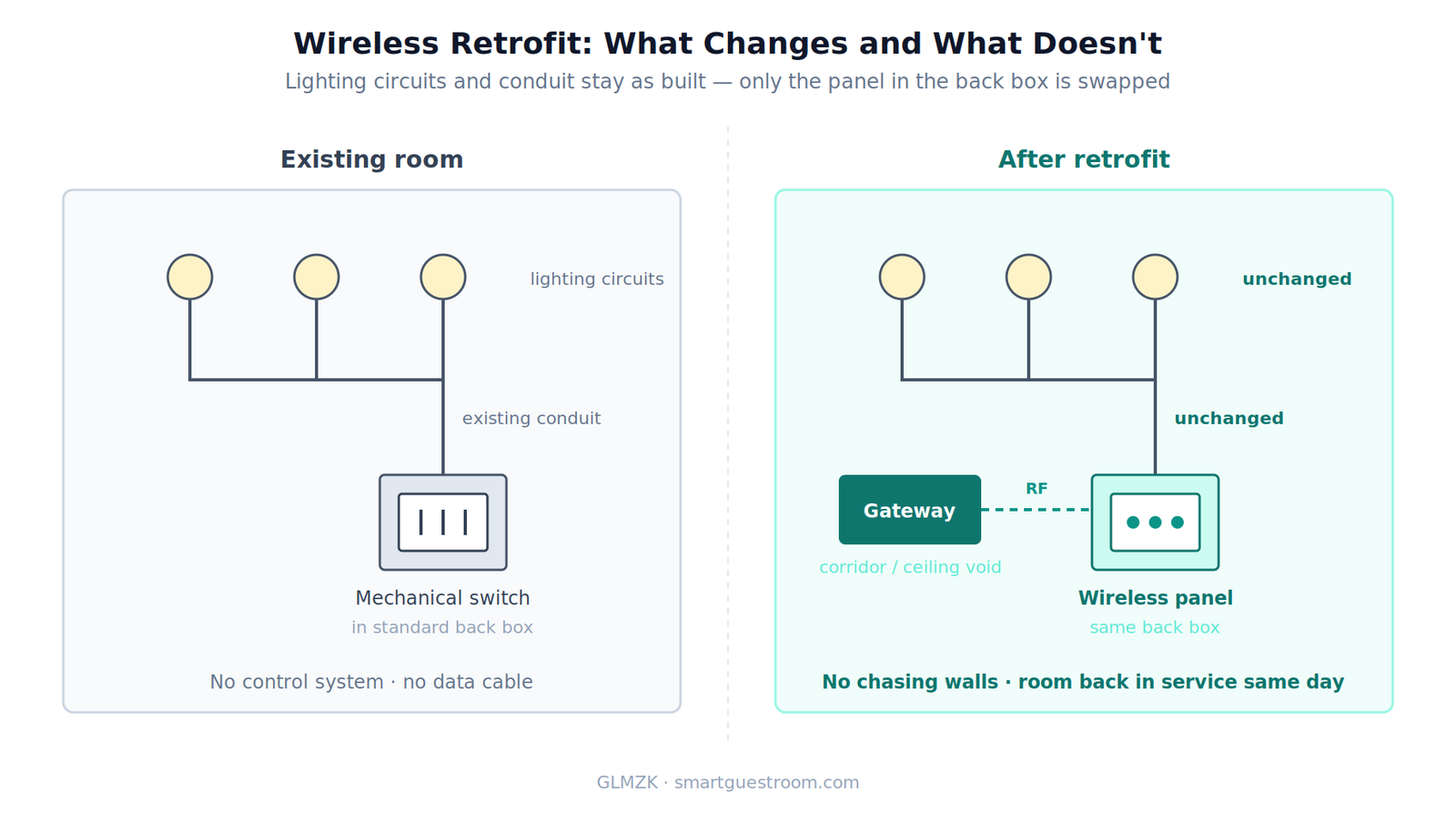
The Wiring Problem in a Retrofit
A conventional smart switch still needs the lighting circuit to pass through it. The switch interrupts the live conductor going to the fixture, exactly like a mechanical switch, and adds control electronics on top.
That is fine in new construction where the electrician runs the circuit wherever the drawing says. In an existing building, the circuit is already routed, and it very often does not pass through the position where the hotel now wants a panel — for example a bedside position that previously had no switch at all.
Running a new circuit means opening the wall.
How Wireless Direct Connection Works
In a wireless direct-connect installation, the switch panel is not in the lighting circuit at all. It has only two connections at the back: live and neutral. No switched live, no lamp return conductor.
The panel uses that supply to power itself. When a button is pressed, it transmits a command wirelessly to a receiving device at the fixture, which does the actual switching.
The practical consequence is that a panel can go anywhere there is a live and neutral pair — which in a hotel room usually means any existing switch position, or a position where a socket circuit already passes.
Three Control Paths, Independently
A well-configured wireless room has three ways to operate the same light, and each works when the others are unavailable:
The wall panel. Physical button, immediate response, no network dependency between panel and receiver.
Voice. A voice assistant in the room can command the same fixture. Importantly, this path does not go through the wall panel. If the wall panel loses power, voice control still operates the light.
Mobile app. Remote control and status visibility. More relevant for serviced apartments and villas than for transient hotel rooms, but useful for engineering staff checking room state.
The independence matters. In a conventional wired installation, if the switch fails, the light cannot be controlled. Here, three separate paths reach the same fixture, and a failure in one does not disable the others.
What This Approach Cannot Do
Be clear about the limits before specifying it, because they are real:
- Reliability depends on radio conditions. Thick concrete walls, metal-framed partitions and dense device populations all degrade wireless performance. A site survey is not optional.
- Latency is higher than a wired circuit. Usually imperceptible, but not identical.
- Receiver access is required. Something has to sit at the fixture end. That means access above the ceiling or inside the luminaire.
- It does not solve everything else. Curtain motors, air conditioning interfaces and card power switches still need their own provision.
- Not suited to very large properties. Beyond a certain scale, the cost of managing a wireless estate exceeds the cost of doing it properly with cable.
The honest summary: this is a renovation technique, not a replacement for a wired RCU system in new construction.
Panel Customisation
Because the panel is decoupled from the circuit, button functions are defined in configuration rather than in wiring. This makes customisation straightforward:
- Button count and layout per room type
- Engraved or printed labels in the hotel’s language and typeface
- Panel colour and material matched to the room finish
- Scene buttons that operate several fixtures at once
- Backlight colour and brightness for night visibility
For a renovation this is a practical advantage — the new panels can match the existing room design rather than forcing a design change.
Where This Fits
| Property type | Suitability |
|---|---|
| Operating hotel, phased renovation | Strong fit — rooms return to service quickly, no wall chasing |
| Serviced apartments | Strong fit — app control is genuinely used by long-stay residents |
| Guesthouses and small properties | Good fit — low point counts, cost sensitive |
| Show rooms and mock-ups | Good fit — fast to install, fast to change |
| New-build hotel, 100+ keys | Poor fit — specify a wired RCU system instead |
How to Evaluate It on a Real Project
Build one room before committing to a floor. Specifically:
- Install a complete room, not a single switch
- Test with the room door closed and the corridor door closed — walls attenuate signal
- Test at a time when the building’s other wireless systems are busy
- Cut power to the wall panel and confirm voice control still works
- Have housekeeping and a maintenance technician use it for a week and report back
A mock-up room costs very little compared with a floor that has to be re-done.
FAQ
Does the wall panel need a network connection?
The panel communicates directly with the receiving device at the fixture. A network connection is required for app control and voice platform integration, not for basic panel-to-light operation.
What happens if the wireless link fails?
The fixture stays in its last state. This is why a second control path — voice or app — is worth having, and why a site survey matters before committing to the approach.
Can this be combined with a wired RCU system?
Yes. A common configuration uses a wired RCU for the main room functions and wireless panels only for positions where new cable would be disruptive, such as an added bedside control.
Can GLMZK customise panel colour, labels and button layout?
Yes. Panel face material, colour, engraving, button count and backlight are all specified per project. Send us the room finish reference and control point list.
Related Solutions
- Smart hotel RCU system
- Guest room control solution
- Hotel lighting and dimming control
- Smart hotel door plate
Contact GLMZK
GLMZK manufactures hotel RCU systems, wired and wireless guest room panels, door plates and key card power switches. We supply contractors and system integrators worldwide, with OEM panel design and full wiring documentation.
Send us your room type, key count and control point list, and we will return a panel schedule and wiring diagram.
Request a specification sheet and quotation | sales@smartguestroom.com