
This is one of the simplest wiring tasks in a hotel guest room, and one of the most commonly done in a way that causes problems eighteen months later. The connection itself takes minutes. The decision about how to route the chain is what determines whether a single loose terminal takes out one panel or five.
The Four Terminals
On a GLMZK RCU host, the RS485 port is marked with four letters. Every RS485 panel has the same four:
| Terminal | Function |
|---|---|
| V | Power supply positive to the panels |
| G | Ground / common reference |
| B | RS485 data B |
| A | RS485 data A |
The rule is letter to letter. V to V, G to G, B to B, A to A. There is nothing to work out and no polarity to determine beyond matching the labels.
Host to First Panel
Run the cable from the host’s RS485 port to the back of the first panel and land each conductor on its matching letter.
Standard network cable is commonly used inside a guest room. Use one twisted pair for A and B — keeping the data pair twisted together improves noise immunity — and separate conductors for V and G. Over guest room distances this is more than adequate.
Keep the RS485 run physically separated from mains cable where the routing allows. Running it in the same conduit as a dimmed lighting circuit is the most common cause of intermittent communication faults that are very difficult to trace later.
Panel to Panel: The Daisy Chain
From the first panel, continue to the second using the same letter-to-letter rule. Then second to third, and so on.
This is the advantage of RS485 over dry contact. One cable leaves the host and serves every panel in the room. No separate run per panel, less conduit fill at the host position, fewer terminations to make and verify.
Two things to get right at each panel:
- Land both the incoming and outgoing conductors on the same terminal. The chain passes through the panel, it does not stop there.
- Tighten properly and dress the conductors. A terminal that is merely touching will work at commissioning and fail after thermal cycling.
The Failure Mode You Need to Design Around
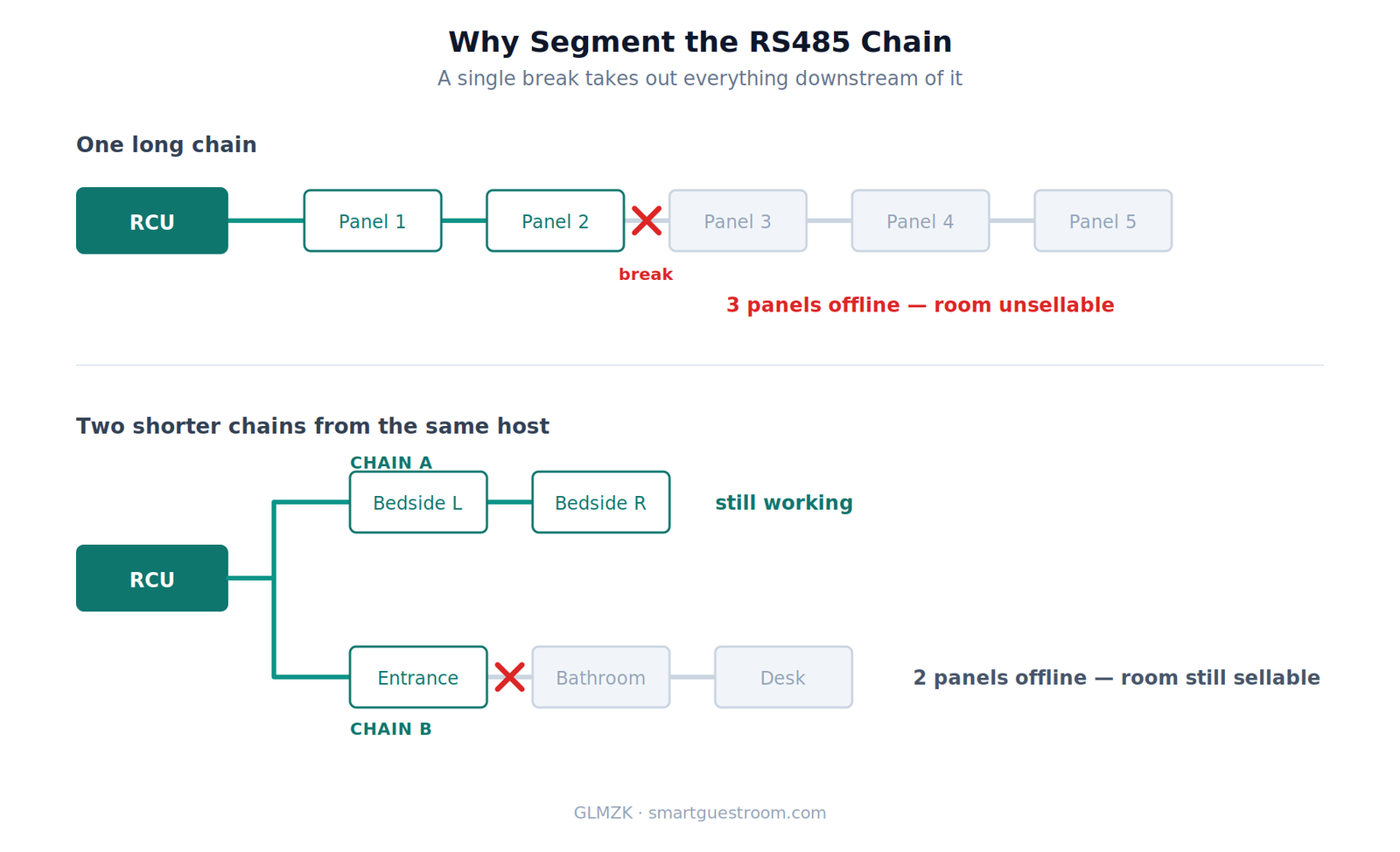
If the communication line breaks at any point, every panel downstream of that break stops responding. Not just the panel at the break — everything after it.
Nothing is wrong with those panels. They simply have no path back to the host.
This is the single real disadvantage of daisy chain wiring, and it is the reason a chain should be planned rather than just run in whatever order is convenient for the installer.
How to reduce the impact
Segment the chain. Instead of one chain serving all panels in the room, run two shorter chains from the host — for example, one to the entrance and bathroom group, one to the bedside panels.
A fault on one chain then leaves the other working. In practice this often means the room stays sellable overnight while a technician attends, rather than being blocked immediately.
Put the most critical panel first. The panel nearest the host is the last one to be affected by a downstream break. In most room types that means the entrance panel, since a guest who cannot control the corridor light or open the door area notices immediately.
Keep the chain physically short. Route it in the order the panels appear along the wall rather than crossing the room and back. Shorter runs mean fewer joints and less exposure to damage during construction.
Addressing
Each panel on a chain needs a unique address so the host knows which one sent a message.
This can be done on site, but it adds time to every room and is a common source of commissioning delay when two panels end up with the same address and both stop working correctly.
GLMZK can pre-address panels by room type before shipment. The installer then mounts and connects only, with no configuration step. On a large property this removes a meaningful number of hours from the programme.
Commissioning Checklist
- Confirm every terminal is letter-matched at both the host and each panel
- Confirm incoming and outgoing conductors are landed together at each intermediate panel
- Power the chain and confirm every panel backlight illuminates — a dark panel usually means V or G is missing
- Press every button on every panel and confirm the correct circuit responds
- Disconnect the last panel in the chain and confirm the others still work — this verifies the chain order matches the drawing
- Record the chain order and panel addresses on the as-built drawing
Step six is the one most often skipped, and the one the hotel’s maintenance team will need in three years.
Recommended Uses
| Application | Approach |
|---|---|
| Standard twin or king room | Single chain, entrance panel first |
| Suite with six or more panels | Two segmented chains from the host |
| Large property, tight programme | Pre-addressed panels shipped by room type |
| Renovation reusing existing conduit | Verify cable type and separation from mains before committing |
FAQ
What cable should be used?
Shielded twisted pair is preferred. Standard network cable is widely used and works over guest room distances. Use one twisted pair for A and B, and keep the run away from mains and dimmed circuits.
Does the chain need a termination resistor?
Over the short distances inside a guest room this is not normally required. For unusually long runs or where communication is intermittent, check the host documentation for termination guidance.
Can panels from different rooms share one chain?
No. One chain serves one room and one host. Sharing across rooms means a fault in one room affects another and makes fault finding much harder.
Can GLMZK supply pre-addressed panels and a wiring diagram per room type?
Yes. Send the room type list and control point schedule and we will return a panel schedule, chain order and wiring diagram before shipment.
Related Solutions
- Smart hotel RCU system
- Guest room control solution
- Hotel lighting and dimming control
- Smart hotel door plate
Contact GLMZK
GLMZK manufactures hotel RCU systems, RS485 and dry contact guest room panels, door plates and key card power switches. We supply contractors and system integrators worldwide, with OEM panel design and full wiring documentation.
Send us your room type, key count and control point list, and we will return a panel schedule and wiring diagram.
Request a specification sheet and quotation | sales@smartguestroom.com